
GOD'S WORD IS LIFE


Week of June 28, 2026
THE PLEDGE IS LARGER THAN OUR PERFORMANCE
Mark Anderson
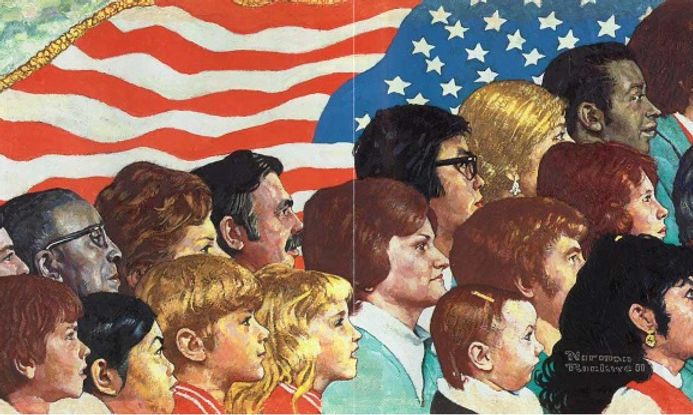
“I pledge allegiance to the flag of the United States of America, and to the republic for which it stands, one nation under God, indivisible, with liberty and justice for all.”
On this Fourth of July, it is worth remembering why the Pledge of Allegiance still belongs in every American school. It matters precisely because the pledge is larger than our performance.
A nation confident enough to teach its children its ideals, and honest enough to admit its failures, has nothing to fear from those words.
A nation should be judged not merely by its failures, but by whether it possesses an ideal capable of condemning them. “Liberty and justice for all” is not a boast about what America has achieved. It is the standard by which America may be measured and found wanting. That is what gives the words their force.
The Pledge also reminds the young that citizenship is not a consumer entitlement. A country is not merely a place from which one demands benefits while sneering at its inheritance. It is something received, maintained, criticized when necessary, defended when required, and passed on.
The Pledge asks something of us. It declares that there is a nation larger than the self, a liberty more demanding than personal appetite, and a call to justice that applies not merely to one’s enemies but to oneself.
Nor is the phrase “under God” an accidental ornament. When Congress added those words to the Pledge in 1954, it was drawing a distinction the age considered perfectly plain: between a republic that acknowledged an authority higher than the state and the Communist/collectivist systems that made the state the highest authority. The words were not inserted as decorative piety. They were meant to deny the state its most dangerous fantasy: that there is nothing above it.
And one suspects that this is precisely why the words still provoke such discomfort. To remove “under God” from the mouths of children is also to remove from their minds the idea that any authority stands above the state. The objection is presented as a courtesy to unbelief, but its consequence is rather more ambitious.
A child who learns that the state is not the highest thing in the universe has already learned the first lesson in resisting tyranny.
A serious republic, therefore, teaches its children that inherited obligations are not chains to be broken but trusts to be received. Citizenship means recognizing that we are beneficiaries of sacrifices we did not make, institutions we did not build, and freedoms we did not create for ourselves. The proper response is not passive entitlement, but active stewardship.
A nation endures when each generation understands that it has been given something worth preserving, improving, and passing on. Its symbols remind us of the loyalties we share. Its sacrifices remind us that our freedoms were purchased by others. Its future depends upon citizens willing to accept responsibility for what they have inherited.
The pledge does not ask children to pretend that America has fulfilled that pledge. It asks them to remember that there is a pledge worth fulfilling. And that freedom is not upheld, in the end, by the state, but by citizens who understand its preservation is their duty.